

Team development with Insights Discovery
By Maria Boese, partner at Unite Consulting. Advisor in team development, leadership and collaboration.
Strong teams are not created by capable people alone. They are built through clear direction, a shared language and deliberate collaboration habits. With Insights Discovery as a starting point, a team can gain a simple, concrete language for differences, communication and collaboration in everyday work.
In short
A strong team is not a team without differences. It is a team that can use its differences deliberately.
Many collaboration challenges are not about a lack of will, but about different preferences for pace, structure, relationships, dialogue and decisions.
Insights Discovery gives the team a shared language that makes it easier to talk about behaviour, expectations and collaboration without making it personal.
The greatest value emerges when insight is turned into concrete agreements about meetings, decisions, feedback and collaboration under pressure.
Why does collaboration break down in strong teams?
Most organisations depend on teams. This is where strategies are turned into action, decisions are qualified, problems are solved and results are created. Yet we often treat teams as if they run by themselves.
We put together a group of capable people, give them a goal and expect collaboration to emerge naturally. But even highly competent teams can struggle if their differences are not understood and used actively.
Some are energised by pace and action. Others need analysis, documentation and time to assess risk. Some think out loud and create energy through dialogue. Others contribute best once they have had time to reflect. Some thrive with clear decisions and defined roles. Others place more weight on relationships, involvement and shared support.
Neither is right or wrong. But the differences can create friction if the team has no language for them.
When differences turn into interpretations
Many collaboration problems start as small interpretations: »She never says anything.« »He always takes up too much space.« »They never make a decision.« »They don’t think things through properly.«
Often it is not the truth. It is an interpretation of behaviour. And when interpretations go unchallenged, they quickly become patterns. The team spends more energy decoding each other than solving the task. Meetings get longer, decisions less clear, and important perspectives surface too late or not at all.
That is why team development is not only about a better atmosphere. It is about making collaboration more conscious and more effective.
What is Insights Discovery?
Insights Discovery is a development tool that helps people and teams understand differences in communication, behaviour and collaboration preferences. The model uses four colour energies as a simple, accessible language for how we typically prefer to work, communicate and make decisions.
The profile is not a verdict on people. It is a mirror that helps the individual understand their own strengths, possible blind spots and the effect they can have on others. For the team, the profiles provide a shared starting point for a dialogue about how collaboration actually works in everyday life.
When Insights Discovery is used well, it is not about putting colours on people. It is about creating more precise communication, better meetings and clearer collaboration agreements.
How we use Insights Discovery in team development
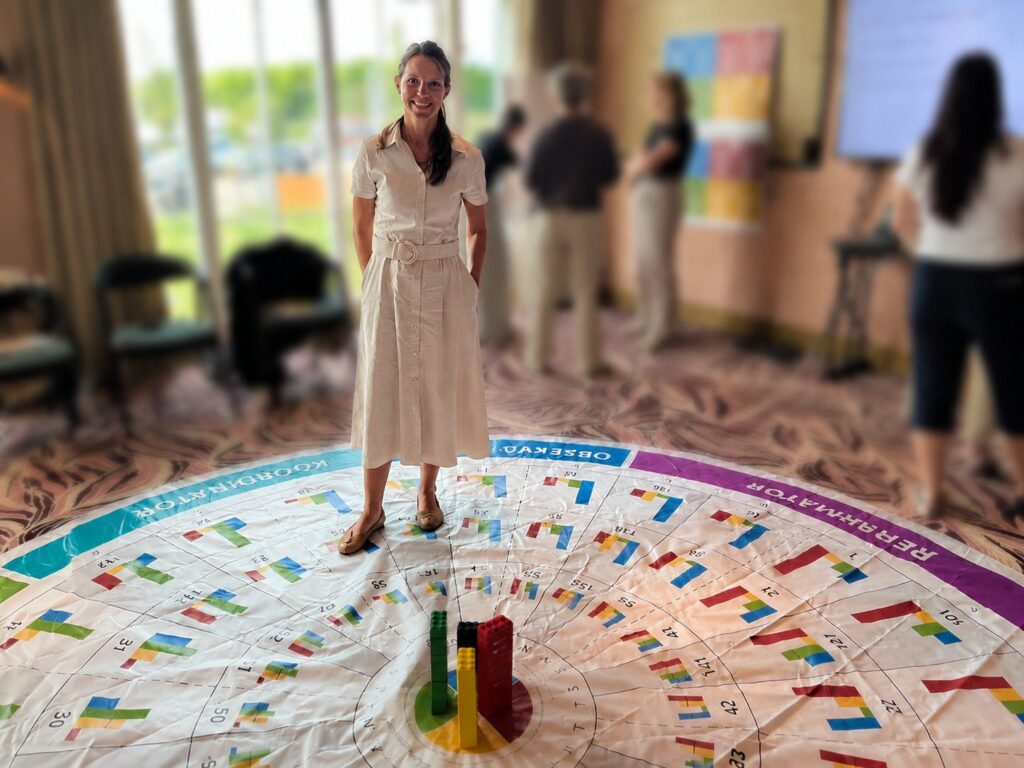
At Unite Consulting we use Insights Discovery as a practical starting point for strengthening a team’s collaboration and results. We usually start with the individual profiles and then use them as the basis for a shared team dialogue. The focus is not only personal insight, but what the team should concretely do differently afterwards.
In a workshop the team works with, among other things:
- the team’s overall preferences and possible imbalances
- communication patterns, strengths and overdone strengths
- decisions, feedback and collaboration under pressure
- how the team brings pace, quality, relationships and risk into the work
- concrete agreements that can be used directly in everyday work
It can become clear, for example, if the team has plenty of drive but too little time for reflection. Or if the team is strong on analysis but struggles to reach decisions and action quickly enough.
From our experience
We have worked with a leadership team where two of the most capable members clashed again and again. One wanted to move quickly, the other wanted to analyse more. Each experienced the other as either rushed or slowing things down.
When we mapped their profiles, it became clear that they did not disagree about the goal, only about the path to it. With a shared language they could agree when the team needed pace and when it needed thoroughness. What had been a conflict became a strength.
From insight to collaboration habits
The real value emerges when insights are turned into new practice. It can be small adjustments that make a big difference: a clearer purpose for meetings, a better distinction between idea generation and decision, material sent out in advance, more deliberate involvement of quieter voices, or a clearer agreement on how the team handles disagreement.
Under pressure in particular, the differences become clear. Pace can be experienced as impatience. Thoroughness as resistance. Silence as a lack of engagement. Direct communication as harshness. The need for involvement as indecisiveness.
The strongest teams do not wait to work on collaboration until it has become difficult. They invest in it before the pressure gets too great.
When does an Insights Discovery team programme add particular value?
- When a leadership team needs stronger shared direction and better decisions across functions.
- When a project team needs to work faster, more coordinated and with less friction.
- When a specialist team needs to strengthen knowledge sharing, feedback and shared responsibility.
- When a global or cross functional team needs a shared language across culture, discipline and distance.
- When a well functioning team wants to lift its collaboration from good to strong.
Strong teams create better results
A strong team is not a team without disagreement. It is a team that can use disagreement constructively. A team where differences are not hidden or smoothed over, but put actively into play.
When it succeeds, collaboration does not just become more pleasant. It also becomes more effective. Decisions get better, misunderstandings fewer, meetings more focused, and energy is spent on the task rather than on internal friction.
Strong teams don’t happen by themselves. But they can be developed when you work deliberately with direction, communication and shared behaviour.
What the research shows
Cognitive diversity: in an analysis of 150 senior teams, the most cognitively diverse teams solved problems fastest. Differences in how people think and process information are a strength when used deliberately. [2]
Shared understanding: teams with shared mental models, a common understanding of the task and of each other, have better team processes and perform better. That is exactly what a shared language creates. [3]
Grounding: Insights Discovery is built on Carl Jung’s typology and is quality assured to European standards (EFPA). The model is a practical tool for dialogue, not a verdict. [1][4]
The research supports the principle: differences used deliberately and a shared language make teams stronger. Insights Discovery is one of the tools that makes it practical in everyday work.
Would you like to strengthen collaboration in your team?
At Unite Consulting we help teams create a shared language, better dialogue and more effective collaboration habits. We use, among other things, Insights Discovery as a starting point for concrete team programmes where insight is turned into new practice in everyday work. Contact us for an informal conversation about how a programme can be tailored to your team.
Frequently asked questions
What characterises a strong team?
A strong team has clear direction, a shared language for collaboration, the ability to handle disagreement constructively and concrete habits for decisions, feedback and communication.
How can Insights Discovery strengthen a team?
Insights Discovery gives the team a simple language for differences, communication and collaboration preferences. It makes it easier to understand one another and make concrete agreements about how to work together.
Is team development only relevant when collaboration is difficult?
No. Team development is also relevant for well functioning teams that want to strengthen performance, decision making, psychological safety and shared execution.
What is the difference between personal insight and team development?
Personal insight is about understanding yourself. Team development is about turning that insight into better shared practice in meetings, decisions, feedback and collaboration under pressure.
Sources
[1] Jung, C. G. (1921). Psychological Types. The theoretical basis for Insights Discovery.
[2] Reynolds, A. & Lewis, D. (2017). Teams Solve Problems Faster When They Are More Cognitively Diverse. Harvard Business Review.
[3] Mathieu, J. E., Heffner, T. S., Goodwin, G. F., Salas, E. & Cannon-Bowers, J. A. (2000). The Influence of Shared Mental Models on Team Process and Performance. Journal of Applied Psychology, 85(2), pp. 273 to 283.
[4] Insights Discovery: Validating the System. insights.com (quality assurance to EFPA).