
Workshop · Culture
Culture Workshop for International Teams
Work better across countries and cultures, in Copenhagen and across Denmark
More and more teams work every day with colleagues in other countries, whether they sit in Bangalore, Chicago, Warsaw or Tokyo. They agree on the goal, but work from different assumptions about communication, decisions, trust and time. A message that sounds clear in Copenhagen can sound blunt in one country and vague in another. A deadline that is fixed for one team can be a target for another. When those differences stay unspoken, the same discussions come back, frustration grows and delivery slows down.
The Culture Workshop makes those differences explicit and practical. It is not about national stereotypes. It is about understanding the expectations your colleagues work from, and agreeing how you will work together.
A workshop delivered in house for your team, or for your team together with colleagues abroad, in Copenhagen, anywhere in Denmark or online, in Danish or English. Half day DKK 16.000, full day DKK 22.000, for the whole team. No travel charge in the Greater Copenhagen area. Outside it, travel and accommodation expenses are charged at cost.
Typical client symptom: “We keep revisiting the same issues, even though everyone says they agree.”
Why cultural differences are easy to miss
Most cultural friction is not about big, visible differences. It sits in small everyday moments: how direct feedback is, who speaks first in a meeting, whether a yes means agreement or only that the message was heard, and whether a deadline is a promise or an ambition. Because we grow up with our own norms, they feel like common sense, not culture.
Culture is also relative. Seen from Denmark, an American manager can seem quite hierarchical. Seen from Japan, the same manager seems remarkably informal. What matters is not where a country sits on its own, but the gap between the people who need to work together.
An everyday example
A Danish manager opens a meeting with colleagues from a more hierarchical culture by asking: “What do you think we should do?” In Denmark this is an invitation to take ownership. In a more hierarchical culture it can sound as if the manager has not done their job, so people wait politely for a clear instruction. The Danish manager reads the silence as a lack of initiative, and the colleagues read the open question as a lack of direction. Both act sensibly by their own norms, and both walk away frustrated.
The answer is rarely to change who people are. It is to make the expectation explicit: when we want input, when a decision is made, and who makes it.
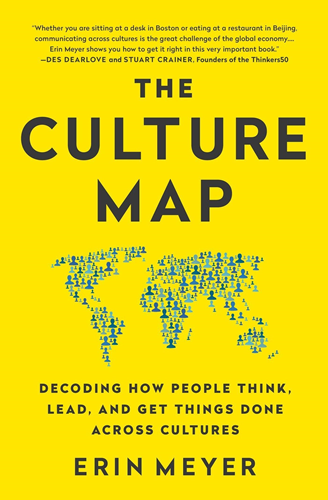
Our foundation: The Culture Map
Our approach builds on the work of Erin Meyer, professor at INSEAD and author of The Culture Map. Her research maps how countries differ on eight scales that shape everyday work, from how we give feedback to how we make decisions. The model helps teams see differences as positions on a scale rather than as right or wrong, and compare their own culture with their colleagues’.
The eight scales- Communicating
- Evaluating
- Persuading
- Leading
- Deciding
- Trusting
- Disagreeing
- Scheduling
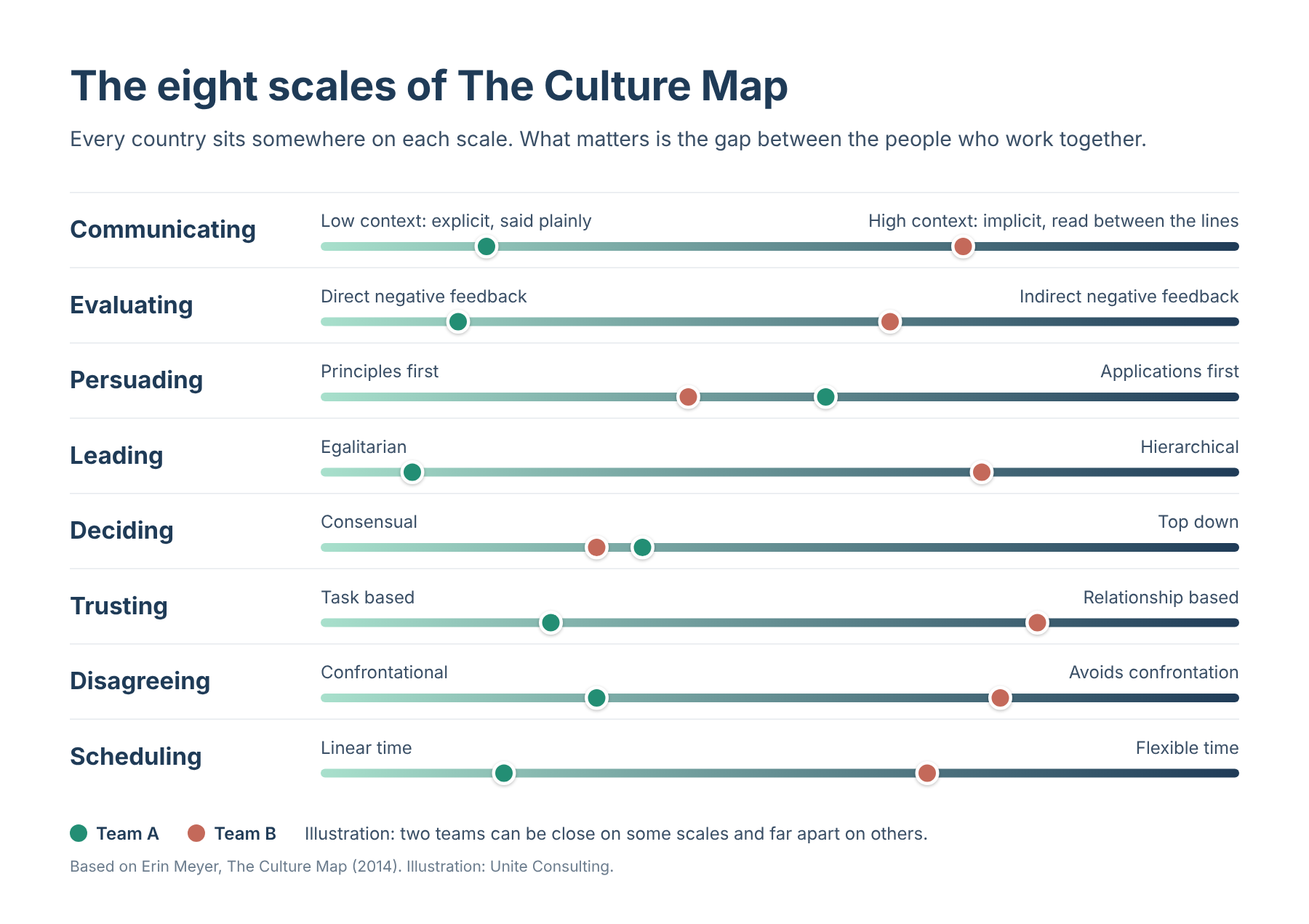
What the scales measure
- Communicating: is good communication explicit and spelled out, or implicit and read between the lines?
- Evaluating: is negative feedback given directly, or softened and given indirectly?
- Persuading: do people want the principle first, or the practical application first?
- Leading: is the ideal boss one among equals, or clearly above the team?
- Deciding: are decisions reached by consensus, or made by the boss?
- Trusting: is trust built through reliable work, or through personal relationships?
- Disagreeing: is open disagreement healthy, or does it damage relationships?
- Scheduling: is time fixed and linear, or flexible and adaptable?
Two scales are often confused. A culture can be hierarchical and still decide by consensus, as in Japan, where proposals are anchored at many levels before they reach the top. And a culture can be fairly egalitarian and still expect the boss to decide, as in the United States. In the workshop, we map your team and your colleagues on the scales that matter most for your collaboration, and agree how to work across the gaps.
Typical outputs
- Shared language for the cultural differences that affect daily work
- Explicit agreements on communication, decision making, trust and time
- Fewer repeated discussions and less rework across sites and borders
- Practical routines that keep the agreements in place as the team changes
- 01MapMake hidden assumptions visible across communication, trust, decisions and ways of working.
- 02DecodeUse practical cultural lenses to understand where differences create friction, confusion or delay.
- 03AlignAgree how the team will work together in practice across key situations and trade-offs.
- 04EmbedTurn the agreed choices into routines, behaviours and leadership habits that support execution.
Why this works
It makes invisible norms discussable, reduces friction across teams and geographies, and turns culture into concrete behaviours and choices.
What we do in practice
• Use Erin Meyer’s Culture Map to build shared understanding and surface hidden assumptions
• Use practical culture lenses to understand differences in communication, trust, authority and pace
• Translate agreed cultural choices into routines, leadership behaviour and follow-up
Also available as a training programme over several sessions, from DKK 16.000
Frequently asked questions
Is this about national stereotypes?
No. National culture is a starting point for understanding, not a label for individuals. The workshop helps people see their own assumptions and their colleagues’, and agree how to work together.
What is The Culture Map?
A model by INSEAD professor Erin Meyer that maps how countries differ on eight scales, such as feedback, leadership, decisions and time. We use it to make the differences in your team visible and practical.
Which countries do you cover?
Any combination of countries. The scales work for any team, whether your colleagues sit in India, the US, Japan, Poland, Brazil or Germany.
Can colleagues from the other country take part?
Yes, in the room or online. The workshop works best when both sides are involved, as in our case with teams in Denmark and India.
What about culture within our own organisation?
For values, safety culture or ways of working within your own workplace, see General Workshop Facilitation. For culture change across the organisation, see Culture Consulting.
What does it cost?
Half day DKK 16.000, full day DKK 22.000, for the whole team. A training programme over several sessions starts from DKK 16.000. No travel charge in the Greater Copenhagen area. Outside it, travel and accommodation expenses are charged at cost.
Not sure where to start?
If you can see something is not working in your team but cannot yet name it, an hour with Maria or Shakeel is the fastest way to find out. We ask a structured set of questions, then send you a written read on what we think is going on and what we would do about it. No fee and no obligation.
info@uniteconsulting.dkGet in touch
Have a question, need more information or want a free conversation? Write to us here and Maria or Shakeel will get back to you.