

A practical workshop for stronger collaboration, better decisions and a healthier speak up culture.
A half day or full day workshop, delivered in house for your team of 10 to 20, in Danish or English, anywhere in Denmark. DKK 16,000 for a half day, DKK 25,000 for a full day, for the whole team.
High performing teams are not the teams with the least disagreement. They are the teams where people feel able to speak up, challenge assumptions, raise concerns, admit mistakes and learn together.
At Unite Consulting, we help leadership teams and functional teams strengthen psychological safety in a practical and performance focused way. Our psychological safety workshops and training sessions are designed to translate the concept into concrete behaviours that teams can use in everyday collaboration, decision making and execution.
Psychological safety is not about comfort, consensus or avoiding difficult conversations. It is about creating the conditions where people can contribute honestly, question decisions, share concerns and learn from mistakes before they become costly.
When psychological safety is low, important issues often stay hidden. Disagreement becomes silence. Risks move into side conversations. Problems are discussed outside the room instead of where decisions are made. When psychological safety is strong, teams make better decisions, collaborate more openly and execute with greater clarity and accountability
Let’s discuss the right psychological safety workshop for your team
Psychological safety as a practical business enabler
Psychological safety is often misunderstood as being nice, comfortable or conflict free. In practice, it is the opposite. It helps teams have more honest conversations, not fewer. It creates the conditions for people to challenge ideas, raise risks and learn faster.
For leaders and teams, psychological safety becomes especially important under pressure. When deadlines are tight, priorities are unclear or decisions need to be made quickly, people need to feel able to say what others may not want to hear.
This is where psychological safety becomes directly linked to execution. Strategies, projects and transformations often fail in the gap between what people know and what they feel able to say. A psychological safety workshop helps make that gap visible and gives the team practical ways to close it.
Psychological safety is shaped by leadership behaviour, especially under pressure. The way leaders respond to questions, concerns, mistakes and disagreement has a direct impact on what the team feels able to say next time.
Our framework: Speak Up, Challenge, Learn, Act
We use our Speak Up, Challenge, Learn, Act model to help teams strengthen psychological safety in a practical and behaviour based way.
The model gives teams a simple structure for understanding what psychological safety looks like in everyday work. It helps move the conversation from abstract intention to concrete team behaviour.
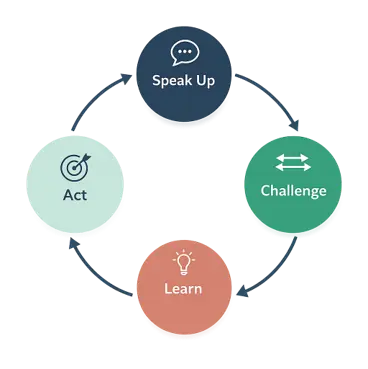
The Speak Up, Challenge, Learn, Act model helps teams translate psychological safety into practical behaviours and stronger collaboration.
Speak Up
Can people raise concerns, share observations and say what needs to be said?
Speak Up is about creating an environment where people feel able to contribute honestly, also when the message is difficult. It includes raising risks, asking questions, admitting uncertainty and sharing perspectives that may challenge the current direction.
Teams with strong speak up behaviour identify problems earlier, avoid hidden risks and make better decisions because more relevant information is available.
Challenge
Can people challenge assumptions, decisions and each other constructively?
Challenge is about making disagreement useful. It is not about arguing for the sake of arguing. It is about helping the team test assumptions, explore alternatives and improve the quality of decisions.
For leadership teams, this is especially important. If people do not challenge each other in the room, disagreement often moves into informal conversations afterwards. That weakens alignment and execution.
Learn
Can the team learn openly from mistakes, feedback and experience?
Learn is about how the team responds when something does not go as planned. In psychologically safe teams, mistakes are not ignored or hidden. They are used as information for learning, improvement and better future performance.
This does not mean lowering accountability. It means combining accountability with curiosity, so the team can understand what happened and improve how it works.
Act
Does the team turn insight into better behaviour and concrete follow up?
Act is where psychological safety becomes visible in practice. It is not enough to have a good conversation in a workshop. The team needs to agree what will change, how they will notice progress and how they will hold each other accountable.
This is why our workshops always focus on practical commitments, not only reflection.
Who is it for?
Our psychological safety workshops are designed for leadership teams and functional teams that want stronger collaboration, better decisions and a healthier speak up culture.
They are particularly relevant for:
Leadership teams that need more honest dialogue and stronger alignment
Functional teams that want better collaboration and trust
Project teams that need risks and concerns to surface earlier
Cross functional teams that depend on open communication across boundaries
Teams under pressure, change or transformation
Teams where important discussions happen outside the room
Organisations that want to strengthen learning, accountability and performance
We facilitate psychological safety workshops in English or Danish, and sessions can be delivered face to face or virtually.
Workshop formats
Psychological safety can be strengthened in different ways depending on your team’s situation, maturity and ambition.
Some teams need a focused workshop to create shared awareness, open the right conversations and agree on immediate actions. Others need a longer development journey to turn insight into sustained behavioural change over time.
We offer two practical formats: a Single Workshop and a Psychological Safety Journey. Both are based on our Speak Up, Challenge, Learn, Act model and are designed to translate psychological safety into everyday team behaviour.
Two ways to strengthen psychological safety
Single Workshop
A focused workshop to create awareness, practical insight and immediate actions.
Best for teams that want a practical introduction to psychological safety, a shared language for speak up culture and concrete actions they can use immediately.
Psychological Safety Journey
A structured development journey to create lasting behavioural change and stronger team performance.
Best for teams that want to go deeper, work with psychological safety over time and connect team behaviour, leadership behaviour, accountability and performance.
Single Workshop
A focused psychological safety workshop to create awareness, practical insight and immediate actions.
The Single Workshop is designed for teams that want to understand psychological safety and identify concrete ways to strengthen it in daily collaboration. The session combines short input, facilitated dialogue, practical exercises and clear team commitments.
It helps the team explore where psychological safety is already strong, where people may hold back and what needs to change in everyday behaviour.
Best when your team needs:
A practical introduction to psychological safety
A shared language for speak up culture and collaboration
A focused conversation about team dynamics
Concrete actions that can be used immediately
Price
Half day DKK 16,000
Full day DKK 25,000
For the whole team, not per person
Psychological Safety Journey
A structured development journey to turn insight into lasting behavioural change and stronger team performance.
The Psychological Safety Journey is designed for teams that want to move beyond a single workshop and strengthen psychological safety over time. The journey combines workshops, reflection tasks, practical experiments, leadership sparring and follow up.
The focus is to help the team translate insight into sustained behaviour change. Between sessions, the team works with practical experiments and applies the learning in real work situations.
This format is especially relevant when psychological safety is closely linked to leadership behaviour, team performance, accountability or a broader change agenda.
Best when your team needs:
Deeper work with team dynamics and leadership behaviour
Sustained improvement over time
Support to turn workshop insight into everyday behaviour
A stronger link between psychological safety, accountability and performance
Price
The number of sessions is agreed with you
Fixed price before we start
Our approach
Every team is different. We start with a short dialogue to understand your team, context and objectives. Based on this, we design a focused workshop or journey that fits your situation.
Our process is simple and practical.

Clarifying needs and focus
We start with an initial dialogue to understand your team, current context and desired outcomes. This ensures the workshop is relevant, focused and connected to your business reality.

Practical team assessment
We help the team reflect on where psychological safety is already strong, and where it may be limiting collaboration, learning or execution. This can be done through dialogue, simple reflection exercises or a short team survey.

Facilitated workshop
We facilitate an interactive workshop using the Speak Up, Challenge, Learn, Act model. The focus is on applying psychological safety directly to your team’s daily collaboration, leadership behaviour and decision making.

Commitments and follow up
The team agrees on practical actions and behaviours to strengthen psychological safety. In longer journeys, we follow up to review progress, support learning and reinforce accountability.
Theoretical foundation
Our approach is anchored in the work of Amy Edmondson, whose research defines psychological safety as a shared belief that the team is safe for interpersonal risk taking. In practice, this means that people can speak up with questions, concerns, mistakes and different views without fear of being punished or humiliated. We combine this research foundation with practical leadership and team development experience. The result is a workshop format that helps teams move from concept to behaviour, from intention to action and from abstract agreement to practical change.
What your team can expect from the workshop
Your team can expect a practical workshop that helps people speak up more openly, discuss challenges more honestly and strengthen trust, collaboration and accountability. The workshop identifies what already works well, where hidden friction or silence may be limiting performance and which behaviours the team can commit to changing. The goal is not comfort. It is better dialogue, stronger decisions and more effective teamwork.
Frequently Asked Questions: Psychological safety workshops and training
What is psychological safety?
Psychological safety is a shared belief that people in a team can speak up, ask questions, raise concerns, admit mistakes and challenge ideas without fear of negative consequences. It is an important foundation for learning, collaboration and performance.
What is psychological safety training?
Psychological safety training helps teams and leaders understand what psychological safety means in practice and how to strengthen it through everyday behaviour. It typically focuses on speaking up, constructive challenge, learning from mistakes, leadership responses and team accountability.
What is a psychological safety workshop?
A psychological safety workshop is a facilitated team session that helps people understand psychological safety and translate it into practical team behaviour. The workshop typically focuses on speaking up, constructive challenge, learning from mistakes and concrete actions for improvement.
Why is psychological safety important in teams?
Psychological safety is important because it helps teams surface risks, share information, challenge assumptions and learn from mistakes. This improves collaboration, decision quality and execution, especially in complex or high pressure environments.
Is psychological safety the same as being nice?
No. Psychological safety is not about being nice, avoiding conflict or making everyone comfortable. It is about creating the conditions for honest dialogue, constructive challenge, learning and accountability.
How does psychological safety improve performance?
Psychological safety improves performance by making it easier for people to share concerns, test ideas, identify risks early and learn from experience. This helps teams make better decisions and execute more effectively.
How do you build psychological safety in a team?
You build psychological safety by creating clear expectations for dialogue, inviting input, responding constructively to concerns, encouraging constructive challenge and learning openly from mistakes. Leaders play a key role because their response often determines whether people will speak up again.
What are examples of psychological safety at work?
Examples include a team member raising a concern before a decision is made, someone admitting a mistake without fear of blame, a colleague challenging an assumption in a constructive way or a leader thanking someone for sharing a difficult message.
What is the role of leaders in psychological safety?
Leaders shape psychological safety through their behaviour. They influence whether people feel able to speak up, challenge, ask questions and admit mistakes. The most important leadership behaviours often show up under pressure.
How does psychological safety support a speak up culture?
Psychological safety supports a speak up culture by making it safer and more normal for people to raise concerns, challenge assumptions and share different perspectives. Without psychological safety, people may stay silent even when they see risks or problems.
What is the difference between psychological safety and trust?
Trust is often about the relationship between individuals. Psychological safety is about the shared climate in a team. A team can include people who trust each other personally, but still lack a team climate where difficult issues are raised openly.
Can psychological safety improve decision making?
Yes. Psychological safety improves decision making because it increases the quality and honesty of information available to the team. When people feel able to share concerns and challenge assumptions, the team is more likely to identify risks and make better decisions.
Who should attend a psychological safety workshop?
Psychological safety workshops are relevant for leadership teams, functional teams, project teams and cross functional teams. They are especially useful for teams that want stronger collaboration, more open dialogue and better decision making.
Can psychological safety and accountability exist together?
Yes. Strong psychological safety does not remove accountability. It strengthens accountability by making it easier to discuss expectations, performance, mistakes and improvement openly.
Can the workshop be delivered in Danish?
Yes. We facilitate psychological safety workshops in both Danish and English. The format can be adapted to Danish teams, international teams and global organisations.
Can the workshop be delivered virtually?
Yes. Psychological safety workshops can be delivered face to face or virtually. The format is adapted to the team, context and desired outcomes.
What is the difference between a single workshop and a psychological safety journey?
A single workshop creates awareness, shared language and immediate actions. A psychological safety journey supports deeper behavioural change over time through multiple sessions, practical experiments, leadership sparring and follow up.
How do we know which format is right for our team?
We help you choose the right format based on your team’s current situation, maturity and objectives. A single workshop can be a strong starting point, while a journey is better when the team wants sustained change over time.
Who is a psychological safety workshop for?
A psychological safety workshop is for leadership teams, functional teams and project teams that want stronger collaboration, better decisions and a healthier speak up culture. It is especially relevant for teams under pressure, teams working across functions or boundaries, and teams where important concerns, risks or disagreements are not always raised openly. Workshops can be facilitated in English or Danish, either face to face or virtually.
When is a psychological safety workshop relevant?
A psychological safety workshop is relevant when a team wants stronger collaboration, better decisions and more honest dialogue. It is especially useful when people hold back concerns, risks are raised too late, meetings stay polite while real disagreement happens afterwards, or important issues are discussed outside the room instead of in the team. The workshop helps the team move from good intentions to practical behaviours by creating a shared language for speaking up, challenging constructively, learning openly and turning insight into action.
How long is a psychological safety workshop?
A single workshop runs as a half day or a full day, depending on how deep your team wants to go and how much time you want to spend agreeing practical commitments. A half day works well for a first shared conversation and immediate actions. A full day gives more room for team dynamics, leadership behaviour and real situations from your everyday work. A Psychological Safety Journey spreads the work across several sessions over time.
How many people can take part?
The workshop is designed for an intact team, typically 10 to 20 people. It works best when the whole team is in the room, including the leader, because psychological safety is built between the specific people who work together every day. For larger groups we can run parallel team sessions.
Where do you run the workshops?
We come to you. Workshops are normally held at your own location or a venue you choose, anywhere in Denmark, and we also travel internationally. We can facilitate virtually where teams are spread across locations.
What does a psychological safety workshop cost?
A half day team workshop is DKK 16,000 and a full day is DKK 25,000. That is the price for the whole team, not per person, and there are no profile or material costs on top. A Psychological Safety Journey is priced on scope, because the number of sessions depends on what your team needs. In every case you get a fixed price before we start, so there are no surprises.
Do you run open courses that individuals can sign up for?
No. We work with whole teams, in house. Psychological safety is created between the people who actually work together, so sending one person on an open course rarely changes anything back in the team. Everything we run is designed for your team, in your context, with your real challenges in the room.
What does the team get afterwards?
The team leaves with a shared language for speaking up and a clear picture of where psychological safety is already strong and where silence is costing you. Afterwards you receive a written summary of the workshop and the actions the team agreed together, so the commitments stay visible once everyone is back at work.